Showing posts with label farmer boy. Show all posts

Farmer Boy - Week 4

CUD:
CUD, n. [See Chew and Jaw.]
1. The food which ruminating animals chew at leisure, when not grazing or eating; or that portion of it which is brought from the first stomach and chewed at once.
2. A portion of tobacco held in the mouth and chewed.
3. The inside of the mouth or throat of a beast that chews the cud.

FLAIL:
FLA'IL, n. [L. flagellum. We retain the original verb in flog, to strike, to lay on, L. fligo, whence affligo, to afflict; plaga, a stroke, or perhaps from the same root as lick and lay. Gr. See Lick.]

PECK:
PECK, n.
1. The fourth part of a bushel; a dry measure of eight quarts; as a peck of wheat or oats.
2. In low language, a great deal; as, to be in a peck of troubles.

COW'S DIGESTIVE SYSTEM:


Rumen Anatomy (Click on the cow's body parts to find out about it's function)

ENERGY:


THRESHING MACHINE:


Threshing Machine (Wikipedia)


GEMS:


HOW TO CLEAN TARNISHED SILVER:


MAUL:
MAUL, n. [L. malleus. See Mall.]
A heavy wooden hammer; written also mall.

MAUL, v.t. To beat and bruise with a heavy stick or cudgel; to wound in a coarse manner.

WITHE:
WITH, WITHE, n. [L., probably a shoot.]
1. A willow twig.
2. A band consisting of a twig, or twigs twisted.

LIVERYMAN:
LIV'ERYMAN, n.
1. One who wears a livery; as a servant.
2. In London, a freeman of the city, of some distinction. the liverymen are chosen from among the freemen of each company, and from their number are elected the common council, sheriff and other superior officers of the city. They alone have the right of voting for members of parliament.

HAYPRESS:


BANKING INFORMATION:


Lots of links about banking and teaching your kids about money can be found here.

"THE ROAD NOT TAKEN" - by Robert Frost


Farmer Boy - Week 3

PHOTOSYNTHESIS:


GROWING PUMPKINS:


BRIDLE:

BRI'DLE, n.
1. The instrument with which a horse is governed and restrained by a rider; consisting of a head-stall, a bit, and reins, with other appendages, according to its particular form and uses.
2. A restraint; a curb; a check.
3. A short piece of cable well served, attached to a swivel on a chain, laid in a harbor, and the upper end drawn into a ship and secured to the bits. The use is to enable a ship, when moored, to veer with the wind and tide.
Bowline bridles are short legs or pieces of rope, running through iron thimbles, by which the bowline attaches to different places on the leech or edge of a large sail

BRI'DLE, v.t. To put on a bridle; as, to bridle a horse.
1. To restrain, guide or govern; to check, curb or control; as, to bridle the passions; "to bridle a muse."
Bridle the excursions of youth.
BRI'DLE, v.i. To hold up the head, and draw in the chin.

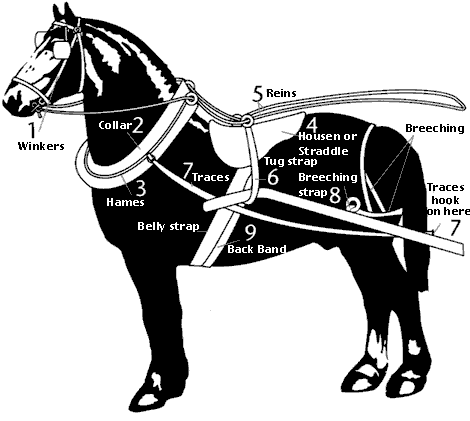
HARNESS:

H`ARNESS, n.
1. Armor; the whole accouterments or equipments of a knight or horseman; originally perhaps defensive armor, but in a more modern and enlarged sense, the furniture of a military man, or offensive, as a casque, cuirass, helmet, girdle, sword, buckler, &c.
2. The furniture of a draught horse, whether for a wagon, coach, gig, chaise, &c., called in some of the American states, tackle or tackling, with which, in its primary sense, it is synonymous.

H`ARNESS, v.t. To dress in armor; to equip with armor for war, as a horseman.
Harnessed in rugged steel.
1. To put on the furniture of a horse for draught.
Harness the horses. Jer.46.
2. To defend; to equip or furnish for defense. 1 Macc.4.

MAKING HOMEMADE ICE CREAM:


HOW TO PICK OUT A RIPE WATERMELON:


RAISING PIGS:


FISH:


HOW TO MAKE EGGNOG:


Grain Cradle
c. 1900

To harvest grain, the crop was usually first cut and then the grain was separated from the stalk or body of the crop. Grain cradles were used for cutting and gathering the crops. The long wooden "fingers" of the cradle gathered the straw as it was cut and deposited it in piles. The cradle was an improvement on a single blade because the fingers acted as extensions of the farmer's arms and made harvesting a little easier.

SELFISH:
SELF'ISH, a. Regarding one's own interest chiefly or soley; influenced in actions by a view to private advantage.

HOW TO TREAT A BURN:


BELGIAN HORSE:


Farmer Boy - Week 2

AUG'ER, n.

An instrument for boring large holes, chiefly used by carpenters, joiners, cabinet makers, wheelwrights and shipwrights. It consists of an iron blade, ending in a steel bit, with a handle placed at right angles with the blade. Augers, made with a straight channel or groove, in some places, are called pod-augers; the modern augers, with spiral channels, are called screw-augers.

MOOSEWOOD TREE:

PATIENCE, n. pa'shens:

1. The suffering of afflictions, pain, toil, calamity, provocation or other evil, with a calm, unruffled temper; endurance without murmuring or fretfulness. Patience may spring from constitutional fortitude, from a kind of heroic pride, or from christian submission to the divine will.

2. A calm temper which bears evils without murmuring or discontent.

3. The act or quality of waiting long for justice or expected good without discontent.

Have patience with me,and I will pay thee all. Matt.18.

4. Perseverance; constancy in labor or exertion.

He learnt with patience, and with meekness taught.

5. The quality of bearing offenses and injuries without anger or revenge.

His rage was kindled and his patience gone.

6. Sufferance; permission. [Not used.]

7. A plant, a species of rumex of dock.

HOW TO MAKE MAPLE SYRUP:


* Why harrow a field? Find out here.


POTATOES:


* Lots of 4th of July links can be found here.

AMERICAN FLAG OF 1867:

DECLARATION OF INDEPENDENCE:

PAR'ASOL, n. [L. sol.]
A small umbrella used by ladies to defend themselves from rain, or their faces from the sun's rays.

Farmer Boy - Week 1

ALMANZO WILDER:
Almanzo Wilder (Wikipedia)
Farmer Boy (Herbert Hoover Presidential Library and Museum)


WOOL PRODUCTION:


RED CEDAR TREES:


WOOD:


BIRD'S NEST PUDDING RECIPE:
Ingredients:
1/2 tsp baking powder
3 eggs
1 pint heavy cream
1/2 tsp ground nutmeg
1/2 tsp salt
1 tsp cream of tartar
1 c brown sugar
1 c flour
1/2 tsp butter
1 c homogenized milk
1/2 c powdered sugar
6 tart apples (about 2 lbs)
1 tsp maple flavoring

Directions:
Step #1 Butter a baking dish (2-quart).
Step #2 Peel & core the apples & place them in the dish.
Step #3 Fill the wholes with brown sugar, pressing slightly, & sprinkle half the nutmeg on top.
Step #4 Place in preheated 350° F oven to start baking while you prepare the batter.
Step #5 Separate the eggs, putting the yolks into a larger bowl & the whites onto a platter.
Step #6 Beat whites with a fork or whisk until they no longer slip from the tilted platter.
Step #7 Beat the yolks until they change color; stir in the maple flavoring & milk.
Step #8 In smaller bowl mix flour, cream or tartar, salt, baking powder, & any remaining brown sugar.
Step #9 Stir this mixture quickly into the liquid.
Step #10 Fold the egg whites into this thin batter.
Step #11 Pour the batter evenly over & around the partly cooked apples & return dish to the oven, baking it until the crust has browned, another 45 mins to 1 hr.
Step #12 While the pudding bakes, stir the powdered sugar & remaining nutmeg into a pitcher of heavy cream.
Step #13 Take the finished pudding directly to the table before it falls, & turn each serving onto a plate so the apple is nested in the fluffy crust.
Step #14 Pour sweetened cream over them.

OTHER LITTLE HOUSE RECIPES:

SOLIDS, LIQUIDS AND GASES: